MBA Surf Blog
GMAT Score for ISB: What You Need for Admission & Scholarships (Case Study)
What GMAT score do you need for ISB admission & scholarships? A case study on GMAT Focus targets, essays, layoffs & interview framing.
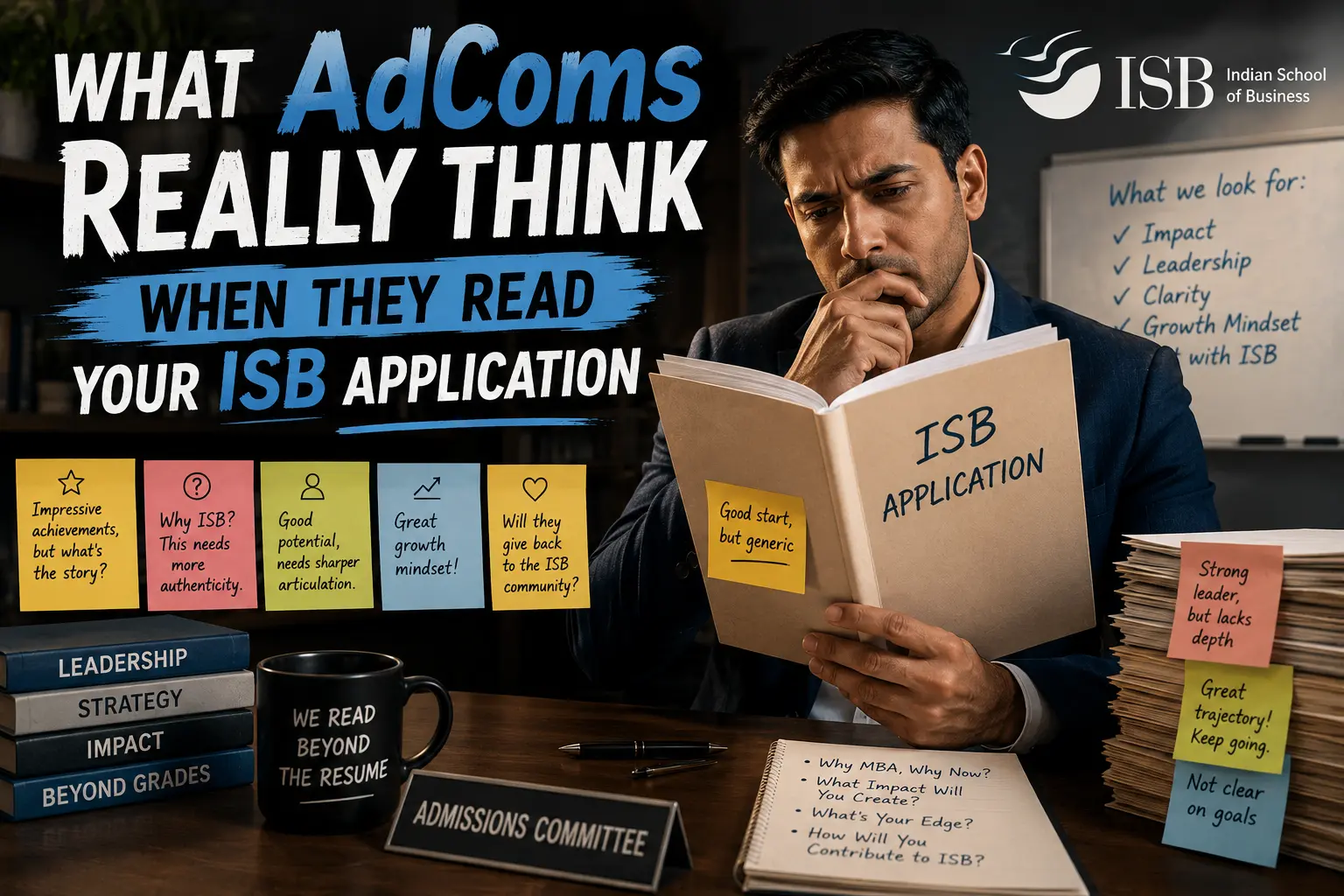
There is a specific type of MBA applicant who has every legitimate reason to get into a top programme and still doesn't. Not because the profile is weak. Not because the GMAT score is low. But because the application tells a story the AdCom doesn't quite believe — and the ISB interview exposes the gap between the packaging and the reality.
Most candidates searching "GMAT score for ISB" want a number. This case study gives you the number. But it also gives you the part a number can't fix: how your profile actually reads to an admissions committee that has already reviewed five hundred applications this season.
The central question here is not "can this candidate get into ISB?" It is "will her application survive a fifteen-minute interview?"
Key takeaways:
ISB's median GMAT Focus score sits around 645 — but profiles with open questions need 685+, pushing 700.
Scholarship-worthy ISB applications typically sit well above the median, not at it.
A bootstrapped side business is a proof of concept. Present it as one, or the interview will punish you.
"Weather report" failure essays — bad market, learned resilience — are the most common self-inflicted wound in ISB essays.
Three job switches due to layoffs is explainable. The pattern is the problem, and the Optional Essay must address judgment, not just events.
The Case Study: A Strong ISB Profile With One Problem
A 26-year-old woman, targeting ISB Round 2. Commerce background, BBA, strong and consistent academics through school and college. Three years of post-graduation work in B2B marketing at early-stage companies.
During undergrad, she built a small coaching community that generated modest but real revenue from paying subscribers. She also attempted a boutique agency that shut down. Across her three years of work, she switched employers three times, each move driven by layoffs tied to startup funding constraints.
On the surface, this reads as a classic ISB resilience narrative. Entrepreneurial hustle, academic consistency, a diversity angle the programme actively values, and a career arc shaped by external forces rather than personal instability.
That reading is not wrong. But it is incomplete. And incomplete readings are where MBA applications go to die.
ISB Admission Criteria: What Strong Academics Actually Do
The grades are strong. Consistent. Unambiguous. In a one-year programme as compressed and demanding as ISB's, the first silent question any AdCom asks is whether the candidate can survive the pace. This transcript answers that question before the first essay is read.
That is its job. It is not a differentiator. It is a permission slip. It gives the rest of the profile room to breathe, and it gives the candidate margin when other parts of the ISB application invite scrutiny.
The mistake would be to build essays around academic achievement. The second mistake would be to assume it speaks for itself in the ISB interview. It speaks. But it speaks quietly. The candidate should acknowledge it once, cleanly, and move on to the parts of the profile that actually require defence.
Entrepreneurship in an ISB Application: Proof of Concept, Not Packaging
This is where coaching often does the most damage.
The candidate built a small knowledge-product business during undergrad. It generated a few lakhs in revenue from a few dozen paying customers. No external funding. No team. No scale.
The instinct is to inflate. To call it a "venture." To frame the revenue as evidence of "business acumen." To position the candidate as a founder.
This is a mistake, because it creates an expectation the ISB interview will not sustain. One sharp question about unit economics, customer acquisition cost, or growth trajectory will reveal the distance between the language and the reality. And once that distance is visible, the AdCom recalibrates everything else in the application downward.
What the candidate actually has is more honest and, frankly, more interesting. She identified a problem she could solve, built a minimal product, convinced real people to pay for it, and sustained it through her own effort. That is customer validation. That is execution. That is a proof of concept.
The application should present it as exactly that. Not a business. A proof that she can build something from nothing and get strangers to trust her with their money. In a pool full of candidates who list "entrepreneurial interest" and mean they once discussed a startup idea over dinner, that is genuinely rare.
The framing is the entire game here. Presented honestly, it is a strength. Presented as something larger than it is, it becomes a liability that poisons the interview.
ISB Essays: Why "Weather Report" Failure Stories Don't Work
MBA admissions advice has converged on a single, repeated instruction: AdComs love failure stories. Show vulnerability. Show growth. Show that you learned.
This is true. It is also, in practice, the most frequently botched part of any ISB essay.
The reason is that most candidates write what I would call a weather report. The structure is always the same. Conditions were difficult. The market shifted. The timing was wrong. The business closed. But I learned resilience. I came out stronger.
That is not a failure story. That is a description of something that happened in the candidate's vicinity. There is no ownership in it. No specific, uncomfortable admission of what the candidate personally got wrong. No evidence that the lesson changed actual behaviour rather than generating a reflective paragraph.
AdComs have read thousands of weather reports. They can identify one in the first two sentences.
The candidate in this case study shut down a boutique agency. The honest question is not "what happened to the market?" It is: what did she specifically misjudge, what would she do differently, and where is the evidence that her decision-making has actually changed? If she can answer that with precision and without reaching for external blame, the failure becomes one of the strongest elements in the application. If the honest answer is mostly external, the story should be handled briefly and carefully rather than built into a central essay pillar.
The difference between a failure story that earns trust and one that erodes it is not the event. It is whether the candidate has actually sat with the version of events where she is partly responsible.
GMAT Score for ISB Admission: Why the 645 Median Isn't Your Target
ISB's median GMAT Focus score sits around 645. For a candidate with a clean profile, a consistent career arc, and no elements requiring explanation, scoring at or slightly above the median is sufficient.
This candidate does not have that profile.
She is applying from a commerce and marketing background in a pool dominated by engineering and consulting. She has three job switches that require context. She has a side business that needs careful framing.
She has a failure that needs honest treatment. Every one of these elements generates a question in the AdCom's mind, and every unanswered question creates drag.
In this situation, the GMAT score is not just a benchmark. It is doing structural work. It is the one element that can close questions before they are asked. A 655 does not do that work. It leaves the questions open. It produces a borderline conversation, a waitlist, or an admit with no scholarship discussion.
The realistic target for this profile is 685 minimum, pushing toward 700. Not because the median demands it. Because when the rest of the application invites scrutiny, the score needs to be the one thing that does not.
GMAT Score for ISB Scholarships: What Actually Wins Money
Merit scholarships at ISB are not awarded to median candidates. They are awarded to candidates the programme wants to publicly claim — and to candidates who would otherwise take a competing offer elsewhere.
In practice, that means scholarship conversations cluster well above the median: 685 and higher on GMAT Focus, with the largest awards concentrating at 700+. The score alone does not win the money. Profile distinctiveness, interview performance, and essay quality decide the rest. But a below-scholarship score removes the candidate from the conversation before any of that can matter.
For this profile, the honest framing is: 685 keeps the scholarship door open. 700+ walks through it. Anything at the median is an admit conversation, not a funding conversation.
Job Switches and Layoffs: The ISB Optional Essay Question Nobody Asks
Three employers in three years. Each departure caused by layoffs. Each one explainable, individually, as a structural event beyond the candidate's control.
The standard coaching advice is to address this in the ISB Optional Essay, frame it as externally driven, and brief recommenders to emphasise resilience and adaptability. That advice is correct. It is also insufficient.
Because a sharp AdCom will ask the question underneath the question, silently, in the privacy of their own evaluation, where the candidate cannot hear it and therefore cannot answer it.
Why did she keep joining companies that were running out of runway?
The funding slowdown was not a secret. It was visible, widely discussed, and trackable from late 2021 onward. A candidate with strong professional judgment — which is precisely what a one-year MBA programme selects for — either reads those signals and positions herself accordingly, or does enough diligence before accepting a role to understand the runway situation. Three sequential misses is not bad luck. It is a pattern. And patterns are what AdComs are trained to identify.
This does not disqualify the candidate. Not remotely. But it means the Optional Essay cannot simply explain what happened. It has to demonstrate that her judgment has evolved. That she now reads signals differently. That the next decision she makes will be a more informed one. Recommenders can vouch for her performance. Only she can vouch for her self-awareness. Those are two different things, and the AdCom knows the difference.
The Verdict: What This ISB Profile Needs
The strengths are real. The academics are legitimately strong. The diversity angle is genuine and valued by the programme. The entrepreneurial proof of concept, framed correctly, is a differentiator. The resilience is evident and earnable.
What the profile does not need is better packaging. What it needs is honesty in four specific places.
A side business narrative that presents the proof of concept as a proof of concept. A failure story that is specific and self-implicating rather than atmospheric. A GMAT score high enough to close the questions that the rest of the profile opens. And an Optional Essay on the job switches that demonstrates forward-looking judgment rather than backward-looking explanation.
Get those four things right and ISB is not a reach. It is a legitimate, achievable target. Get them wrong, and the candidate walks out of a perfectly decent interview wondering why the call never came.
FAQs: ISB GMAT Score, Round 2 & Profile Questions
What is the average GMAT score for ISB?
ISB's median GMAT score sits around 645 on the GMAT Focus Edition (roughly 700–710 on the old classic scale). ISB publishes a wide admit range, but the working median is the number to plan against.
What GMAT score do I need for an ISB scholarship? Scholarship conversations typically begin at 685+ on GMAT Focus, with the largest merit awards concentrating at 700+. The score gets you into the conversation; profile distinctiveness and interview performance win the money.
Can I get into ISB with job switches or layoffs? Yes. Layoffs are common and explainable. What matters is the pattern and the framing: multiple switches in a short span invite a judgment question, and the Optional Essay must show forward-looking decision-making, not just an explanation of events.
Is ISB Round 2 a good time to apply? Yes. A large share of the class is admitted in Round 2 and scholarship funds remain available. The trade-off is a bigger, more competitive pool — so your GMAT score and essays must be ready before the deadline, not after it.
Does ISB value entrepreneurship and marketing profiles? Yes, when the evidence is real. Paying customers beat pitch decks. A marketing profile genuinely differentiates in an engineer-heavy pool — but the GMAT score and essays have to carry their weight.
If you see your own profile in this case study, the question is not whether you can get into ISB. The question is whether your application can survive the honest version of your story. Book an ISB profile evaluation call and find out before the AdCom does. Bring the hard questions.
Hashtags: #ISB #ISBAdmission #GMAT #GMATFocus #GMATScore #MBAAdmissions #ISBInterview #ISBEssays #MBAScholarship #Bschool #MBAAspirants #ISBHyderabad #ISBMohali #MBAInIndia #Round2 #ProfileEvaluation #MBA2027